The Sparrow
Maggie Horsburgh • August 10, 2021

“His eye is on the sparrow, and I know He watches me.” Matthew 6:26


The other week I was doing laundry, hanging clothes out on the line. I went to pull the line in, and as I did a little sparrow that had been sitting on it got caught in the wheel. Feathers were flying, he was distressed. I quickly reversed direction, releasing this poor little creature. He was unsettled and unstable trying to stay on the line, tail twitching and wings flapping. He was clearly unbalanced. His partner came to his side trying to understand his stress and pain. She couldn’t do anything but be there. He eventually flew into a neighbouring tree, and she went with him.


I love birds. We have a huge assortment of birdhouses in the backyard, with a potential for more if we could find a place to mount them. We have wrens and finches, mourning doves and cardinals, sparrows and chickadees. We feed them all year round.
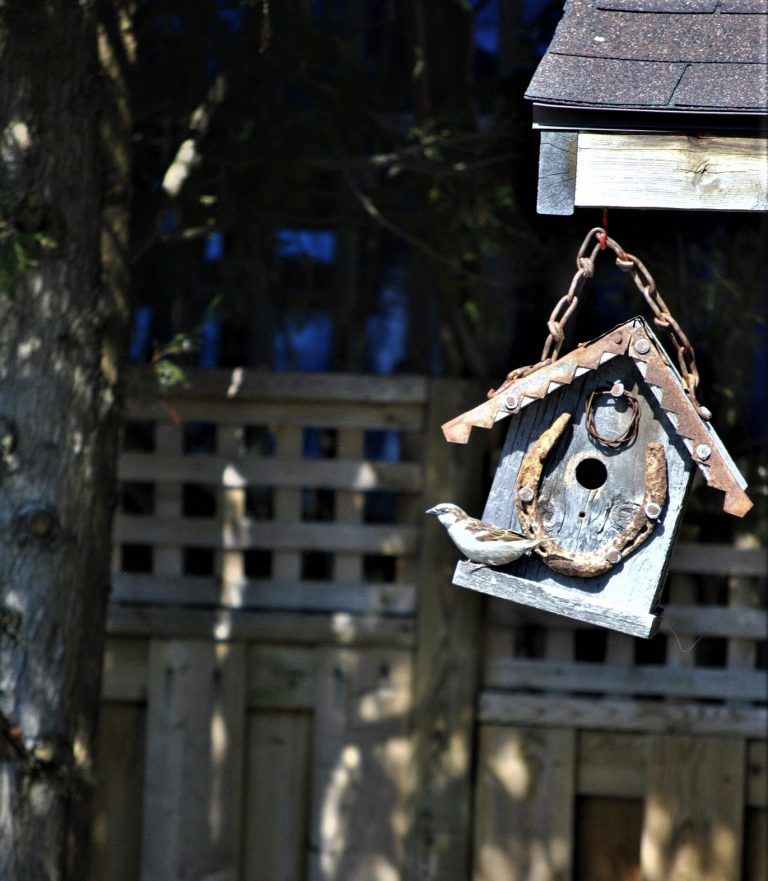
Sparrow house

Each birdhouse has babies to feed, with mother and father both working hard to provide nourishment to their growing offspring. Back and forth from feeder to babies to feeder for more. It’s never ending. Every once in awhile an adult will flutter down to our pond, stepping into the water flow where they can grab a quick drink and a bath. It’s quite magical.


I’ve also noticed that I am quite present when this is going on around me, and this simple time in my backyard gives me hours of contentment and entertainment. The birds are very comfortable with me being out there with them, and my husband says that I am like Snow White. It makes me chuckle every time.

The male sparrow builds the nest in the hopes of persuading a female to mate. I have watched a male spend weeks checking out a new hole – in and out, assessing, wondering if it would suit. Then he begins to build. Other birds have partners and babies to feed, but the male will sit alone by his new nest leaving only to get building materials. If patient, he will eventually be one of the lucky ones, finding a mate to raise their family. I find the whole process fascinating.


So, having this male bird in distress because of my actions brought great anxiety and sadness to me. Would he just go away to die? Do they mate for life? Would she be left alone to feed these babies on her own? Would the babies be abandoned? It broke my heart.


A few days later I was sitting quietly by my pond, watching a frog waiting for bugs, and of course all the activity around the bird feeders and nests. Without warning a lone male sparrow sat awkwardly on the fence alongside me, perched on one leg. He softly landed by the waterfalls of the pond, hopped in for a quick drink then left again. I kept watching for him to return, and a few minutes later he drifted by me. I instantly knew it was him. What a gift it was to see that he was alright, and back on task. It was like he needed me to see him, to know that he was fine.


He fluttered over to the feeder then to the nest. Instead of landing on the perch, he awkwardly leaned into the hole using his wings as leverage to press into his peeping chicks.  He couldn’t land the way a normal sparrow would, but he had adapted. Such resilience!


Watching this bird survive his trauma has been a gift, and I was reminded of a few things through this ordeal.


During the trauma of my divorce there was a scripture that I had clung to as if it was life itself. I let its truth sweep over me again and again – if a little bird would always be cared for, I knew that I would also be fine. It gave me the strength to go on.


I was scared and stressed. I wanted to crawl into a hole, curling into the fetal position, weeping in helplessness and insecurity. Was I going to be alright? What would happen to me? How was I going to survive the changes that were soon to transpire? Was I going to have to sell my home? Where would I go? How will I afford this?


Watching this little bird, it dawned on me how I had also adapted when my life had become broken and shattered. I didn’t know how to go on, but somehow I did. I had adjusted to a new single life. A life of aloneness, but peace. Fulfillment in my career and relationships. A time of focus on my mental well being. A chance to journal my heart’s pain. A time to lean into God as He wrapped His wing around me, giving me a quiet place to weep and grieve and heal. I felt safe there.


The bird hadn’t gone off to die, or to give up on his family, but rather adjusted his placement on the perch in order to fill those starving mouths. His partner would come in for a landing right after him, and away they went fulfilling the tireless task of filling baby bellies. His desire to live and serve his family far outweighed his desire to go someplace quiet to die. He knew he mattered as I had learned that I mattered.


Sometimes we hurt others without meaning it and sometimes others hurt us. When he landed near me, I felt absolved of any guilt that I was feeling. I felt forgiven. Forgiving others, seeking forgiveness, forgiving ourselves – it matters to those on our journey. In forgiveness there is the process of giving it, receiving it, and accepting it. Forgiving (and being forgiven) is liberating for all parties.


Sparrows do not mate for life. Yet, in his distress his partner stayed as his faithful one for a season. Just being there was enough. For us, it’s ok to cry and to fall apart with that kind of friend. We don’t have to be strong when we are not, and it’s in those times that healing comes. Friends will come, stay, then go along their journey, but the right one always seems to be there when we need them.


When the time has come that the brood leaves the nest, these two little ones will part ways. I’ll be watching to see if he brings a new one home to start again.


This little bird will never be the same, and neither will I…and that’s okay. We both have picked up the amazing attitude of doing things differently, while still being part of our families and society. I promise you, it’s going to be alright.

The information provided on this website does not, and is not intended to, constitute legal advice; instead, all information, content, and materials available on this site are for general informational purposes only. Views expressed are my own. Please consult a lawyer for advice on legal matters.

Share this post

Man reading a book on a couch in a bright living room while another person uses a laptop in the background
By Maggie Horsburgh June 25, 2026
I remember sitting in my parents' living room, watching them go about an ordinary Sunday afternoon. My mother puttering in the kitchen. My father flipping through his horse magazines. They weren't unhappy. There was a certain comfort in the life they had built together, a familiar rhythm shaped by decades of shared history. They had become experts at coexistence. The sharp edges had softened with time, but so too had some of the wonder. They moved around one another with the ease of people who knew each other's habits by heart, yet I sensed a quiet distance between them. Not conflict. Not loneliness. Just an absence of curiosity, anticipation, or connection. Life seemed less like an adventure they were experiencing together and more like a routine they had mastered. And as I sat there watching them, a question settled heavily in my chest: Is this it? Is this what we're working toward? We fall in love, get married, raise our children, build careers, pay the bills, save for retirement, and then one day find ourselves sitting across from the person we've spent a lifetime with. If the children are gone, the careers are winding down, and the responsibilities have eased, what remains? Is the goal simply to endure together? Or is there meant to be something more? The question felt disloyal at the time, maybe even selfish. After all, wasn't this exactly what my parents had worked so hard to build? But once it appeared, I couldn't shake it. That question stayed with me for years. It turns out I wasn't the only one asking it. That uncomfortable question is driving a shift in family life right now. Across North America, more couples over fifty are choosing to end long-term marriages - a phenomenon researchers call grey divorce . Its rise has forced us to rethink some long-held assumptions about marriage, aging, and what we want from the second half of life. And if you're in that season of life, there's a good chance you know at least one couple it has touched. Maybe it's touched you. For many people, the children leaving home doesn't just create empty bedrooms. It creates space to finally look at life itself. Without the distractions, responsibilities, and busyness that once held everything together, some couples find themselves facing a difficult truth: they no longer recognize the life they've built or the person sitting across from them. We're Not Who We Were at 25 Here's the thing nobody says at the wedding: people change. A lot. The person you married at 27 may be almost unrecognizable at 60, and so might you. That's not a failure. That's just life doing what life does. Many grey divorces aren't dramatic. There's no affair, no blow-up moment, no single villain. It's more of a slow drift. Two people who built a life around kids, careers, and keeping the wheels turning suddenly find themselves across the breakfast table with nothing left to manage. Realizing they don't actually know each other all that well anymore. Or worse, they know each other perfectly, and that's the problem. Retirement Breaks Things Retirement was supposed to be the reward. The destination. You grind for 35 years, you get the gold watch, and then life begins. Nobody warned us that "life beginning" requires actually knowing what kind of life you want. Particularly for men, work is identity. Its structure, purpose, status, and social life all rolled into one. When it disappears, the vacuum can be enormous. Some guys handle it beautifully and discover themselves. A lot don't. And instead of confronting that loss of purpose, it gets directed at the marriage. Suddenly, couples who used to co-exist comfortably around busy schedules are home together 24 hours a day. Routines that held a marriage together evaporate. Tension shows up in places it never did before. I've seen perfectly decent couples unravel in the first year of retirement because they had no idea who they were to each other outside of the logistics of running a family. The Unfulfilled Dream Factor This part gets me every time. I've watched many people spend their best years waiting. Waiting until the kids are grown. Waiting until retirement. Waiting until then . And then "then" arrives and there isn't enough of it left. My mother may have had a list. Things she wanted to do, places she wanted to go, parts of herself she planned to explore "someday." I imagine if she had a list, she secretly kept it on a notepad in her bedside drawer. Maybe it existed only in her mind. If there were a list of things, I don’t know if she ever did them. That haunts me more than I'd like to admit, and I think it's part of why I can't judge anyone who, at 65 or 75 or even older, decides they're done waiting. I once worked with a couple in their early 80s who were separating after 60 years of marriage. Everyone around them was shocked. I wasn't. I could see that she had one chapter left, and she was not going to spend it the same way she'd spent the rest. What struck me wasn't the separation. It was the fact that she still had dreams. I was relieved that she still had dreams. The House in the Middle Okay, here's where I put on my real estate hat, because this is where things get genuinely complicated. In Ontario, the matrimonial home is treated as a joint asset, full stop. It doesn't matter whose name is on the deed, who paid the mortgage, or how long you've lived there. It's split equally. And that's just the house. Pensions, RRSPs, investments accumulated during the marriage — all of it goes into the pot. When you add legal fees into the mix, something shifts quickly. A couple who once had a comfortable retirement plan can suddenly find themselves as two individuals trying to build separate lives on what used to support one household. The financial reality of that change is often more significant than people expect. And perhaps what makes it even more complex is timing. There is no long runway to recover. Divorce in your 30s is painful, but there are decades of earning ahead. Divorce at 65 or 70 means rebuilding on whatever time is left, with far less room for adjustment. There's also the inheritance piece, and it's awkward but worth stating: when one or both spouses move on to new relationships, estate planning gets complicated fast. Kids who thought they understood what was coming can find themselves blindsided. That resentment is real, and it's worth thinking through early. These are not abstract financial structures. They are lived realities inside families. My husband likes to describe his work in his seventies as “laying fresh pavement” every day because the runway, as he puts it, technically ended, and he is simply extending it as he goes. I think about that often when I look at this stage of life and these kinds of transitions. Some people are still building. Some are beginning again. And some are doing both at the same time. That’s what makes this stage of life so complex. Not just emotionally, but structurally, practically, financially. Everything matters more because there is less time to absorb the impact. You Have More Options Than You Think When it comes to the family home, couples have real choices. Sell and split. One spouse buys the other out. There are creative arrangements that work when both parties approach the situation practically rather than emotionally… though I won't pretend that's easy when you're grieving a 40-year marriage at the same time. What matters most is getting the right people around you early. A family lawyer who understands late-life divorce. A financial planner who can show you what both paths actually look like. And a Realtor who has seen this before and won't treat your home like just another listing. Because it isn't. Grey divorce is often hard. It can be expensive and emotional, and for many people, it reshapes what they thought their future would look like. But it can also be the beginning of something you never allowed yourself to consider before. With eyes open, good advice, and honest support, some people find their way into a life they hadn’t yet imagined. What that life looks like depends on what people are willing to imagine next.
Leaky chrome faucet dripping water against a warm yellow background
By Maggie Horsburgh May 4, 2026
If you’ve just separated and you’re staring down a house that needs work… whether you’re preparing to sell or settling in for the long haul, this is one of the parts nobody prepares you for.